
📅 Current as of August 2026 · by Cameron DeJong, Top 100 Virgin Voyages First Mate
Your Cruise Cabin Is Not a Bedroom. It Is Your Recovery Room at Sea.
Most people choose a cruise cabin by asking how impressive it looks in a photograph.
That is the wrong first question.
Your cabin is the place that returns energy to the vacation. It is where you sleep after Scarlet Night, reset after a hot port day, escape the soundtrack for twenty quiet minutes, change plans without an audience, and decide whether you have enough left for one more show.
A beautiful cabin that solves none of your actual friction can be a poor value. A smaller cabin that protects your sleep, steadies your stomach, shortens the walk, or gives you a private patch of daylight can change the entire voyage.
⚡ Quick Answer: Do not begin with “Which cabin is best?” Begin with “What does this cabin need to help me recover from?” Rank sleep, motion, quiet, daylight, and access. Spend where the room removes your biggest source of friction, not where the category name sounds most impressive.
The Cabin Recovery Compass
Before comparing square footage or scrolling through cabin tours, score these five needs from one to five. A five means the need can materially affect your day. A one means you are flexible.
Cabin Recovery Compass
Rank the friction. Then choose the room.
Sleep
Darkness, bedding, climate, and distance from late-night or early-morning activity.
Motion
How strongly you feel movement and whether location changes your comfort.
Quiet
Sensitivity to music, chairs, doors, elevators, service areas, and corridor traffic.
Daylight
A view, a balcony, or simply natural light that helps you reset and orient.
Access
Walking distance, elevator reliance, bathroom layout, and any documented accessibility need.
Your highest score deserves the first dollar and the least compromise.
This framework is deliberately not a cabin ranking. A ranking pretends every traveler values the same thing. The compass exposes the tradeoff that matters to you.
1. Sleep: The Amenity You Use for Eight Hours
A darker room can be a feature, not a failure. Virgin currently describes Insider cabins as a strong fit for travelers who prioritize sleep or take shorter voyages. Without a window, they can become remarkably dark. For some Sailors, that is exactly the point.
Other travelers wake better with natural light, want to see the weather before dressing, or need a private transition between the energy of the ship and the quiet of bedtime. For them, a Sea View or Sea Terrace may return more value every morning than a specialty dinner ever could.
Location matters just as much as category. Ask what is directly above, below, across from, and near the room. A cabin beneath a public deck, beside a busy service area, or on a high-traffic corridor can be perfect for a heavy sleeper and miserable for someone who hears every chair and door.
No deck-plan reading can guarantee silence. It can reduce avoidable surprises.
2. Motion: Choose for Your Body, Not the View
A ship moves. Weather, speed, sea state, heading, and your own sensitivity all matter. No cabin location can promise a motion-free voyage.
In general, a lower and more central location tends to feel less movement than a very high cabin or one far forward or aft. That does not make “low and midship” the universal answer. Someone who rarely feels motion may gladly trade a little more movement for the view, the balcony, or proximity to a favorite space.
If motion is your five on the Recovery Compass, treat location as a requirement before treating the category as an aspiration. Our separate Virgin Voyages seasickness and cabin-location guide goes deeper on that specific decision.
3. Quiet: Read the Deck Plan Vertically
Travelers often inspect the cabins on either side and stop. Sound does not.
Read one deck above and one deck below. Look for large public spaces, venues, gyms, pools, galleys, elevators, laundry or service zones, and doors that may create foot traffic. Then ask a more useful question than “Is this cabin quiet?”
What kind of sound bothers me, and at what time?
A night owl may not care about evening music but hate a 6:30 a.m. setup overhead. A light sleeper may want distance from elevators; a traveler with limited stamina may value that elevator more than the silence. “Quiet” and “convenient” can pull the cabin in opposite directions.
4. Daylight: A Balcony Is More Than a Photograph
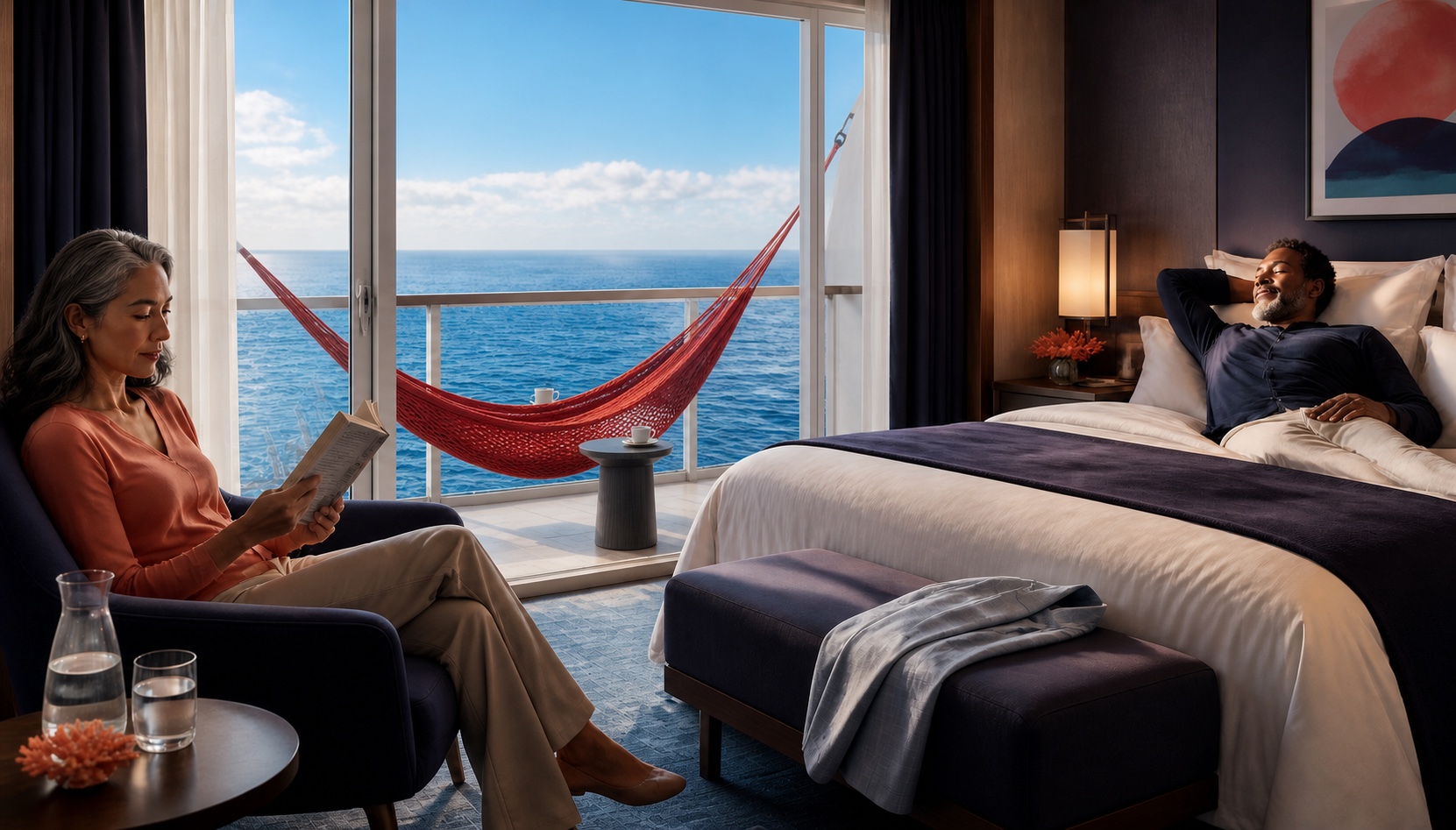
Virgin’s Sea Terrace cabins add natural light, a balcony, and, on most terraces, the line’s signature hammock. The useful question is not whether the hammock looks wonderful. It does. The useful question is what you will do with that private outdoor space.
Will it be the ten-minute reset after a port? A quiet coffee before your companion wakes? A place to decompress when the pool deck feels busy? If so, the terrace is part of your recovery system.
If you plan to be out from breakfast until bedtime and mostly want a dark, cool place to sleep, paying for the balcony may not remove any real friction. That money could create more value somewhere else in the trip.
And if a cabin is labeled “Limited View,” ask what is limited and how that interacts with your priority. An obstruction matters enormously if an open horizon is the reason you are upgrading. It may matter very little if you mainly want daylight and fresh air.
5. Access: Convenience Is a Luxury, Too
A beautiful room at the end of a long corridor can extract a small toll every time you return to it. That toll is invisible on the cabin page.
Consider walking distance, elevator use, the spaces you expect to visit often, bathroom configuration, doorway and turning space, and any documented accessibility need. Accessible cabins are not “better-located regular cabins”; they are limited accommodations intended for travelers who need their features. Request the right support early and verify the exact room specifications with Virgin.
For everyone else, proximity is still a valid preference. A traveler recovering from a knee injury, managing fatigue, or simply planning frequent outfit changes may gain more from an efficient route than from a higher deck.
The Category Ladder Is Not a Value Ladder
| Cabin direction | What it may solve | What to verify |
|---|---|---|
| Insider | Darkness, lower cost, sleep-first short voyage | Location, layout, comfort without natural light |
| Sea View | Daylight and outside orientation without a terrace | Exact view, location, bed configuration |
| Sea Terrace | Private fresh air, daylight, decompression space | Obstruction, hammock availability, location |
| RockStar suites | More space, suite features, service and access benefits | The live list of inclusions, layout, and whether you will use them |
The categories above summarize a decision, not every subcategory or feature. Virgin currently lists five broad cabin families and many variations inside them. Exact layouts, sizes, views, amenities, and benefits can vary by ship and room, so use the live Virgin Voyages cabin pages and current cabin-selection guide for the room you are considering.
The Two-Cabin Test
When two cabins are close in price, do not ask which is objectively better. Complete these sentences:
Cabin A
“This room gives me ______, but I accept ______.”
Cabin B
“This room removes ______, but I give up ______.”
Then choose the sentence that protects the vacation you actually intend to have.
For a celebration voyage, private outdoor space may become part of the memory. For a first-time Sailor worried about motion, the central location may be the better upgrade. For a four-night trip built around shows and nightlife, a dark Insider can be an extremely rational choice. For someone who needs quiet breaks from stimulation, a terrace may be the difference between joining dinner and staying depleted.
Why Recovery Belongs in the Cabin Decision
Research on recovery experiences consistently points to psychological detachment, relaxation, a sense of control, and positive off-work experiences as meaningful ingredients in well-being. Vacation research also suggests that pleasure, relaxation, savoring, and control help explain how restorative a trip feels.
A cruise cabin cannot manufacture well-being. It can create the conditions for a traveler to step away, regulate stimulation, sleep, and regain a sense of control over the day.
That is why the “cheapest room versus fanciest room” debate misses the real decision. The right cabin is the one that spends the budget on recovery you will use.
Tell us what drains you. We will help choose what restores you.
CamJon compares the exact room, location, fare, and live tradeoffs, not just the category photo.
Sources and further reading
Cabin details: Virgin Voyages cabins and its 2026 cabin-selection guide. Recovery research: Headrick and colleagues’ meta-analysis of recovery experiences and de Bloom and colleagues’ vacation well-being study. Research describes patterns, not a guaranteed individual outcome.
Cameron DeJong is the Managing Partner of CamJon Travel, a Top 100 Virgin Voyages First Mate agency. He is a Certified Travel Associate, a CLIA member, and has specialized in Virgin Voyages since the line’s first sailing in 2021. CamJon Travel LLC is an independent agency affiliated with Sava Travel. Sava Travel is registered with the State of Florida as a Seller of Travel, Registration No. ST45948. Cabin features, locations, accessibility, fares, and availability are controlled by the applicable supplier and should be verified for the specific ship and sailing.
About the Author

Cameron DeJong
Cameron DeJong is the Managing Partner of CamJon Travel and a recognized leader in the cruise industry, officially named a Top 100 First Mate in North America for Virgin Voyages in 2025. His expertise is built on a foundation of professional rigor; he is a Certified Travel Associate (CTA) through The Travel Institute and a member in good standing of the Cruise Lines International Association (CLIA). This dedication to professional standards is transparent and verifiable. His CLIA affiliation can be confirmed using Personal ID #00303911 on the official CLIA verification portal.
These credentials anchor his specialized focus on Virgin Voyages. As a Top 100 First Mate in North America for 2025, Cameron brings knowledgeable, firsthand guidance to every Sailor. Having been a specialist since the cruise line's inaugural voyage in 2021, he possesses an unparalleled understanding of every ship, Sailor Loot strategy, and itinerary nuance. Through expert planning and in-depth articles, Cameron leverages this comprehensive knowledge to ensure every traveler's voyage is seamless, informed, and absolutely brilliant.